
跳转至内容
Merck
CN

G8171

藤黄酸

≥95% (HPLC), powder

别名:

β-藤黄酸, 1,5-甲醇-1H,3H,11H-呋喃(3,4-g)吡喃(3,2-b)氧杂蒽-1-巴豆酸, B"-Guttiferrin, 藤黄酸

登录 查看组织和合同定价。

选择尺寸


关于此项目

经验公式(希尔记法):
C38H44O8
化学文摘社编号:
分子量:
628.75
PubChem Substance ID:
UNSPSC Code:
12352200
Assay:
≥95% (HPLC)
Form:
powder
Quality level:
技术服务
需要帮助?我们经验丰富的科学家团队随时乐意为您服务。
让我们为您提供帮助
技术服务
需要帮助?我们经验丰富的科学家团队随时乐意为您服务。
让我们为您提供帮助

产品名称

藤黄酸, ≥95% (HPLC), powder

InChI

1S/C38H44O8/c1-20(2)10-9-15-36(8)16-14-24-29(39)28-30(40)26-18-23-19-27-35(6,7)46-37(33(23)41,17-13-22(5)34(42)43)38(26,27)45-32(28)25(31(24)44-36)12-11-21(3)4/h10-11,13-14,16,18,23,27,39H,9,12,15,17,19H2,1-8H3,(H,42,43)/b22-13-/t23-,27+,36-,37+,38-/m1/s1

InChI key

GEZHEQNLKAOMCA-RRZNCOCZSA-N
SMILES string

C\C(C)=C\CC[C@@]1(C)Oc2c(C\C=C(\C)C)c3O[C@@]45[C@@H]6C[C@@H](C=C4C(=O)c3c(O)c2C=C1)C(=O)[C@]5(C\C=C(\C)C(O)=O)OC6(C)C

assay

≥95% (HPLC)

form

powder

color

yellow to orange

solubility

DMSO: ≥10 mg/mL
H2O: insoluble

storage temp.

−20°C

Quality Level

正在寻找类似产品? 访问 产品对比指南

Features and Benefits

该化合物在受体分类和信号转导手册的 半胱天冬酶 页面上有详细描述。如需浏览其他手册页面,请点击此处

Biochem/physiol Actions

藤黄酸可作为半胱天冬酶活化剂和细胞凋亡诱导剂。
藤黄酸可作为半胱天冬酶活化剂和细胞凋亡诱导剂,在细胞周期的G2/M期引起不可逆的停滞。

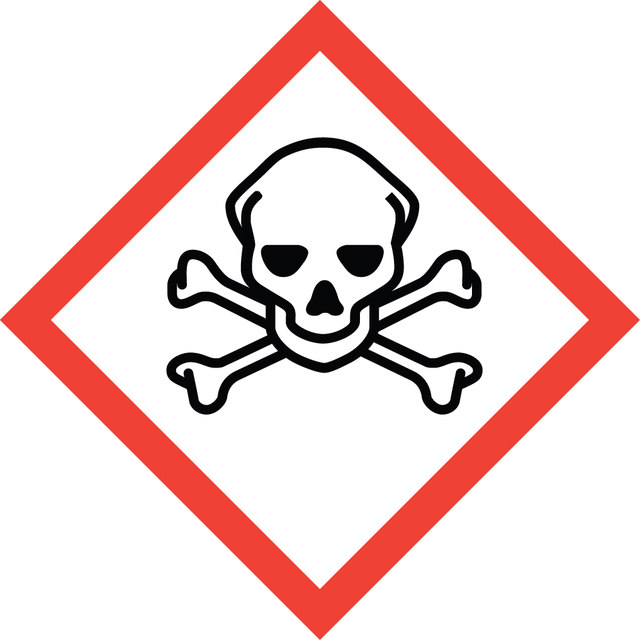
pictograms

Skull and crossbones

signalword

Danger

Hazard Classifications

Acute Tox. 3 Oral - Eye Irrit. 2 - Skin Irrit. 2 - STOT SE 3

target_organs

Respiratory system

存储类别

6.1C - Combustible acute toxic Cat.3 / toxic compounds or compounds which causing chronic effects

wgk

WGK 1

flash_point_f

Not applicable

flash_point_c

Not applicable

ppe

Eyeshields, Faceshields, Gloves, type P2 (EN 143) respirator cartridges


历史批次信息供参考:

分析证书(COA)

Lot/Batch Number

没有发现合适的版本?

如果您需要特殊版本,可通过批号或批次号查找具体证书。

已有该产品?

在文件库中查找您最近购买产品的文档。

访问文档库

Hao-Peng Sun et al.
Chemistry & biodiversity, 9(8), 1579-1590 (2012-08-18)
The natural product gambogic acid exhibits high potency in inhibiting cancer cell lines. Rational medicinal modifications on gambogic acid will improve its physicochemical properties and drug-like characters. To investigate the structure-activity relationship of gambogic acid and also to find rational
Jing Geng et al.
Inflammation research : official journal of the European Histamine Research Society ... [et al.], 62(2), 165-172 (2012-10-16)
Gambogic acid (GBA) targeted Heat shock protein 90 (Hsp90) and prohibited TNF-α/NF-κB signaling pathway. It can be inferred that the anti-inflammatory activity of GBA results from inhibiting the cytokine production via NF-κB signaling pathway. We used the RAW264.7 cell line
Jing Yang et al.
Journal of natural products, 75(6), 1108-1116 (2012-06-06)
Gambogic acid (1) is a cytotoxic caged xanthone derived from the resin of Garcinia hanburyi. Compound 1 selectively induces apoptosis in cancer cells, at least partially, by targeting the stress response to reactive oxygen species (ROS). However, the molecular mechanism
Xiaofen Li et al.
Cell reports, 3(1), 211-222 (2012-12-25)
Gambogic acid (GA) is a natural compound derived from Chinese herbs that has been approved by the Chinese Food and Drug Administration for clinical trials in cancer patients; however, its molecular targets have not been thoroughly studied. Here, we report
Abhishek Shetty et al.
Plant physiology and biochemistry : PPB, 118, 643-652 (2017-08-15)
The plant derived xanthanoid gambogic acid (GA) is well known for its anticancer activity. To date, biological actions of GA on plant system have not been reported. In the present study, we evaluated the potential acute genotoxic activity of GA

我们的科学家团队拥有各种研究领域经验,包括生命科学、材料科学、化学合成、色谱、分析及许多其他领域.

联系客户支持