

biological source
mouse
Quality Level
antibody form
purified antibody
antibody product type
primary antibodies
clone
SMI-99, monoclonal
form
liquid
contains
≤0.1% sodium azide as preservative
species reactivity
guinea pig (weakly), mammals
should not react with
chicken, porcine
manufacturer/tradename
Calbiochem®
storage condition
OK to freeze, avoid repeated freeze/thaw cycles
dilution
(ELISA (1:1000)
Immunoblotting (1:1000)
Immunocytochemistry (1:1000)
Frozen Sections (1:1000)
Paraffin Sections (1:1000))
isotype
IgG2b
shipped in
wet ice
storage temp.
−20°C
target post-translational modification
unmodified
Gene Information
human ... MBP(4155)
General description
纯化的小鼠单克隆抗体。识别~21 kDa髓鞘碱性蛋白(MBP)。
识别大鼠脑组织中约21 kDa的髓鞘碱性蛋白。不识别14 kDa形式。识别大多数哺乳动物物种。
该抗髓鞘碱性蛋白小鼠单克隆抗体(SMI-99)经验证可用于ELISA、免疫印迹、免疫细胞化学、冷冻切片、石蜡切片以检测髓鞘碱性蛋白。
Immunogen
人髓鞘碱性蛋白
表位:氨基酸131-136内
Application
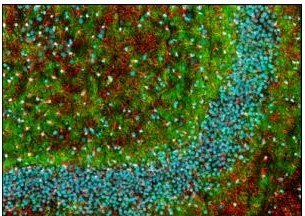
ELISA(1:1000)
免疫印迹法(1:1000)
免疫细胞化学(1:1000)
冷冻切片(1:1000)
石蜡切片(1:1000)
Other Notes
Evers, P. and Uylings, H.B.1997.J. Neurosci. Methods72, 197.
Shin, R.W., et al. 1991.Lab. Invest.64, 693.
Shin, R.W., et al. 1991.Lab. Invest.64, 693.
识别大多数哺乳动物物种的MBP。不能识别~14 kDa形式的MBP。检测发育中和成人髓鞘和发育中的少突胶质细胞。还可以区分少突胶质细胞与星形胶质细胞、小胶质细胞、神经元以及脑组织切片中的其他细胞。与抗髓鞘碱性蛋白小鼠单克隆抗体(SMI-91)(目录号NE1020)和/或抗髓鞘碱性蛋白小鼠单克隆抗体(SMI-94)(目录号NE1018)结合,该抗体可用于正常和病理性髓鞘形成进展的免疫细胞化学研究。在单个系统中,应对抗体进行滴定以获得最佳结果。
Legal Information
CALBIOCHEM is a registered trademark of Merck KGaA, Darmstadt, Germany
Disclaimer
毒性:标准处理(A)
Still not finding the right product?
试用我们的 产品选型工具 工具缩小选择范围
存储类别
11 - Combustible Solids
wgk
WGK 1
flash_point_f
Not applicable
flash_point_c
Not applicable
Jane L Zhu et al.
Journal of translational medicine, 20(1), 41-41 (2022-01-26)
Morphea is an autoimmune, sclerosing skin disorder. Despite the recent emphasis on immune dysregulation in morphea, the role of autoantibodies in morphea pathogenesis or utility as biomarkers are poorly defined. Autoantigen microarray was used to profile autoantibodies from the serum
Michela Losurdo et al.
Brain sciences, 10(4) (2020-04-16)
Traumatic brain injury (TBI) commonly results in primary diffuse axonal injury (DAI) and associated secondary injuries that evolve through a cascade of pathological mechanisms. We aim at assessing how myelin and oligodendrocytes react to head angular-acceleration-induced TBI in a previously
Gerben van Hameren et al.
Acta neuropathologica communications, 7(1), 86-86 (2019-06-13)
Mitochondria are critical for the function and maintenance of myelinated axons notably through Adenosine triphosphate (ATP) production. A direct by-product of this ATP production is reactive oxygen species (ROS), which are highly deleterious for neurons. While ATP shortage and ROS
全球贸易项目编号
| 货号 | GTIN |
|---|---|
| NE1019-100UL | 04055977209884 |