
OP143

Anti-MDM2 (Ab-3) Mouse mAb (4B11)
liquid, clone 4B11, Calbiochem®
别名:
Anti-Ubiquitin Protein Ligase, Anti-p53 Binding Protein, Anti-Murine Double Minute Chromosome-2
登录 查看组织和合同定价。
选择尺寸
关于此项目
NACRES:
NA.41
UNSPSC Code:
12352203
Clone:
4B11, monoclonal
Species reactivity:
mouse, human
Application:
—
Citations:
6
biological source
mouse
antibody form
purified antibody
antibody product type
primary antibodies
clone
4B11, monoclonal
form
liquid
does not contain
preservative
species reactivity
mouse, human
manufacturer/tradename
Calbiochem®
storage condition
OK to freeze, avoid repeated freeze/thaw cycles
dilution
(Immunoblotting (2 µg/mL, chemiluminescence)
Immunofluorescence (1 µg/mL)
Immunoprecipitation (1 µg/reaction)
Paraffin Sections (2.5 µg/mL, heat pre-treatment required))
isotype
IgG2a
shipped in
wet ice
storage temp.
−20°C
target post-translational modification
unmodified
Quality Level
Gene Information
human ... MDM2(4193)
mouse ... Mdm2(17246)
General description
Purified mouse monoclonal antibody. Recognizes the ~90 kDa (apparent MW) MDM2 protein.
Recognizes the ~90 kDa (apparent MW) MDM2 protein in A549 cells. May also recognize the ~60 kDa and ~90 kDa isoforms of MDM2.
This Anti-MDM2 (Ab-3) Mouse mAb (4B11) is validated for use in Immunoblotting, Immunofluorescence, Immunoprecipitation, Paraffin Sections for the detection of MDM2 (Ab-3).
Immunogen
Epitope: within amino acids 383-491
Human
full-length, recombinant human MDM2
Application
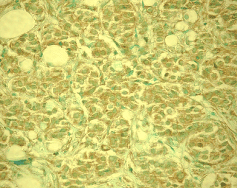
Immunoblotting (2 g/ml, chemiluminescence)
Immunofluorescence (1 g/ml)
Immunoprecipitation (1 g/reaction)
Paraffin Sections (2.5 g/ml, heat pre-treatment required)
Packaging
Please refer to vial label for lot-specific concentration.
Physical form
In 50 mM sodium phosphate buffer, 50% glycerol.
Preparation Note
Following initial thaw, aliquot and freeze (-20°C).
Analysis Note
Positive Control
A549 cells
A549 cells
Other Notes
Marchetti, A., et al. 1995. J. Pathol.175, 31.
Barak, Y., et al. 1993. EMBO. J.12, 461.
Ladanyi, M., et al. 1993. Cancer Res.53, 16.
Leach, F. S., et al. 1993. Cancer Res.53, 2231.
Oliner, J. D., et al. 1993. Nature362, 857.
Momand, J., et al. 1992. Cell69, 1237.
Oliner, J. D., et al. 1992. Nature358, 80.
Fakharzadeh, S. S., et al. 1991. EMBO. J.10, 1565.
Barak, Y., et al. 1993. EMBO. J.12, 461.
Ladanyi, M., et al. 1993. Cancer Res.53, 16.
Leach, F. S., et al. 1993. Cancer Res.53, 2231.
Oliner, J. D., et al. 1993. Nature362, 857.
Momand, J., et al. 1992. Cell69, 1237.
Oliner, J. D., et al. 1992. Nature358, 80.
Fakharzadeh, S. S., et al. 1991. EMBO. J.10, 1565.
May also recognize the ~60 kDa and ~90 kDa isoforms of MDM2. Antibody should be titrated for optimal results in individual systems.
Legal Information
CALBIOCHEM is a registered trademark of Merck KGaA, Darmstadt, Germany
Disclaimer
Toxicity: Standard Handling (A)
未找到合适的产品?
试试我们的产品选型工具.
存储类别
10 - Combustible liquids
wgk
WGK 3
法规信息
新产品
此项目有
U Kaindl et al.
Leukemia, 28(3), 600-608 (2013-11-19)
ETV6/RUNX1 (E/R) is the most common fusion gene in childhood acute lymphoblastic leukemia. It is responsible for the initiation of leukemia but also indispensable for disease maintenance and propagation, although its function in these latter processes is less clear. We
Junhui Li et al.
Molecular cancer therapeutics, 21(4), 535-545 (2022-02-09)
High frequency of KRAS and TP53 mutations is a unique genetic feature of pancreatic ductal adenocarcinoma (PDAC). TP53 mutation not only renders PDAC resistance to chemotherapies but also drives PDAC invasiveness. Therapies targeting activating mutant KRAS are not available and
Julian Aiken et al.
FASEB journal : official publication of the Federation of American Societies for Experimental Biology, 30(3), 1120-1134 (2015-11-19)
We demonstrated in a previous study that murine double minute (Mdm)-2 is essential for exercise-induced skeletal muscle angiogenesis. In the current study, we investigated the mechanisms that regulate Mdm2 activity in response to acute exercise and identified VEGF-A as a
Lauren E Cowen et al.
Scientific reports, 9(1), 13097-13097 (2019-09-13)
The 14-3-3-related protein SMG7 plays critical roles in regulation of DNA damage response and nonsense-mediated mRNA decay (NMD). Like 14-3-3, SMG7 engages phosphoserine-dependent protein interactions; however, the precise role of phosphorylation-mediated SMG7 binding remains unknown. Here, we show that DNA
Wendy M Swetzig et al.
Oncotarget, 7(13), 16049-16069 (2016-02-26)
MDM2 and MDM4 are heterodimeric, non-redundant oncoproteins that potently inhibit the p53 tumor suppressor protein. MDM2 and MDM4 also enhance the tumorigenicity of breast cancer cells in in vitro and in vivo models and are overexpressed in primary human breast
我们的科学家团队拥有各种研究领域经验,包括生命科学、材料科学、化学合成、色谱、分析及许多其他领域.
联系客户支持