
Photometric Determination of Iron in Soil
Introduction
The determination of iron in soil is important as iron content contributes to soil characteristics such as color and composition and is used in the differentiation of soil types. Iron oxides, such as hematite, can significantly influence soil color, particularly in soils with low organic matter content. Iron in soil can exist in different forms, including free and non-free iron, with free iron further classified into crystalline and amorphous forms. These variations influence soil properties and are relevant for soil characterization.1
A range of analytical methods is available for iron determination, including atomic absorption spectroscopy, ion chromatography, inductively coupled plasma techniques, and ultraviolet-visible spectrophotometry. Among these, spectrophotometric methods are widely used due to their selectivity, sensitivity, simplicity, and cost-effectiveness.2
Experimental
This application note details the photometric determination of iron in soils after its extraction.
Method
In a buffered medium iron(II) ions react with a color reagent (depending on test kit, for 1.14761 and 1.14549 a triazine derivative; for 1.14896 2,2´-bipyridine; for 1.00796 1,10-phenanthroline is used) to form a red or red-violet complex that is determined photometrically.
The 1,10-phenanthroline method is analogous to APHA 3500-Fe B and DIN 38406-1.
Measuring Range
Applicable Sample
Soil samples
Reagents, Instruments, and Materials
Test /Reagent Kit(s)
For the measurement one of the following Spectroquant® test kits is necessary.
- Spectroquant® Iron Cell Test (1.14549)
- Spectroquant® Iron Cell Test* (1.14896)
- Spectroquant® Iron Test (1.14761)
- Spectroquant® Iron Test (1.00796)
*not compatible with Move 100
Instrument(s) & Devices
For the measurement one of the following Spectroquant® photometers is necessary:
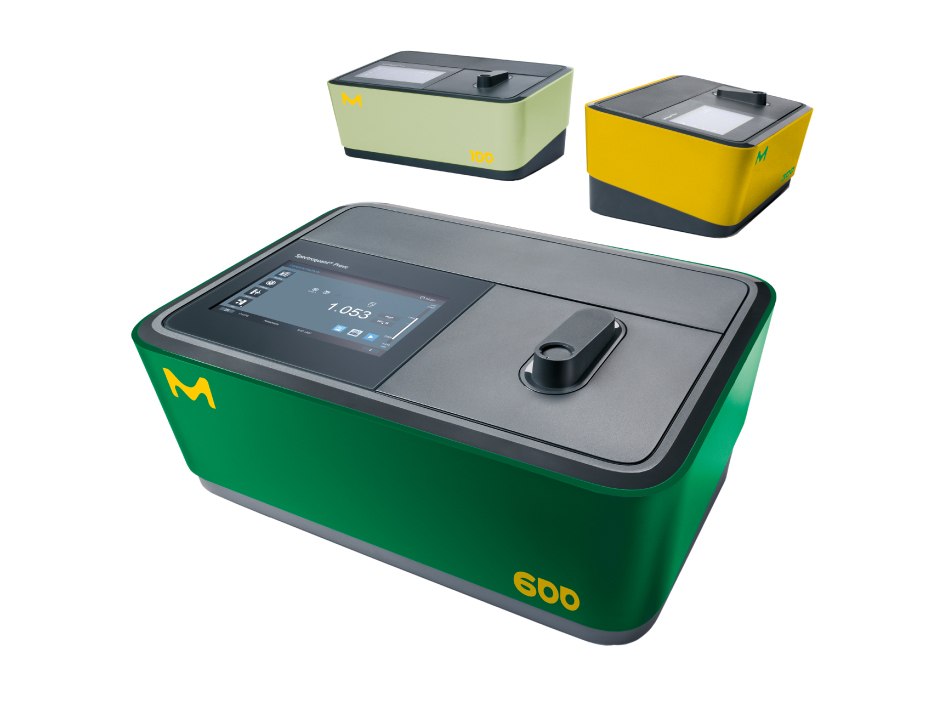
- Spectroquant® VIS Spectrophotometer Prove 100 plus (1.73026)
- Spectroquant® UV/VIS Spectrophotometer Prove 300 plus (1.73027)
- Spectroquant® UV/VIS Spectrophotometer Prove 600 plus (1.73028)
- Spectroquant® Colorimeter Move 100 (1.73632)
Note: Also, legacy Spectroquant® instruments are suitable.
Software for Data Transfer
Optional Spectroquant® Prove Connect to LIMS software package (Y.11086) to transfer your data into an existing LIMS system.
Instrument Accessories
If a reagent test (not cell test) is used, choose one of the following cells depending on the measuring range.
- Rectangular cell 10 mm (1.14946)
- Rectangular cells 20 mm (1.14947)
- Rectangular cells 50 mm (1.14944)
Other Reagents and Accessories
- Hydrochloric acid 25 % for analysis (1.00316)
- Hydrochloric acid 1 mol/L for analysis (1.09970)
- Sodium hydroxide solution 10 % for analysis (1.05588)
- MQuant® pH-Indicator strips pH 0 – 6 (1.09531)
- Water for analysis (1.16754)
- Analytical balance
- Standard laboratory glassware (e.g., glass beakers) and pipettes
- Shaker or stirring plate
- Spatula
- Sieve
- pH-meter
- Charcoal activated for soil test
- Folded filter
Analytical Procedure
For more information on the measurement, see the packaging insert for the test.
Sample Preparation
- In a glass beaker place 10 g of air-dried and sieved (mesh 2 mm) sample, with 100 mL hydrochloric acid 1 mol/L and a spatula-tip full of charcoal activated for soil tests and mix well for 1 hour. The pH value should be 1 - 2 (check with pH-indicator strips). If necessary, adjust with hydrochloric acid 25 %.
- Afterwards adjust the pH value of the suspension to 3.0 with sodium hydroxide solution 10 %, using a pH meter.
- Then remove the undissolved matter by filtration through a folded filter and wash the filter residues 3 times with water for analysis.
- Collect the filtrate and the washings in a 200-mL volumetric flask, finally fill up to volume with water for analysis and mix well.
Using Cat. No. 1.14549: Procedure and Measurement
For more information on the measurement, see the packaging insert for the test,
Procedure
- Pipette 5.0 mL Pretreated sample into a reaction cell and mix.
- Add 1 level blue microspoon (in the cap of the Fe-1K bottle) Reagent Fe-1K, close the cell tightly, and shake vigorously until the reagent is completely dissolved.
- Leave to stand for 3 min (reaction time), then measure the sample in the photometer.
Measurement
- For photometric measurement the cells must be clean. Wipe, if necessary, with a clean dry cloth.
- Measurement of turbid solutions yields false-high readings.
- The pH of the measurement solution must be within the range 3.2 - 4.5.
- The color of the measurement solution remains stable for at least 60 min after the end of the reaction time stated above.
Hints for Measurement
- It is recommended to zero the method each new working day. To do this, open the method, either by manually selecting the method or by inserting a barcoded cell. Tap the <Settings> button and select the <ZERO ADJUSTMENT> menu item. After prompting, insert the 16 mm zero cell through the corresponding opening. The zero adjustment is performed automatically. Confirm the performance of the zero-adjustment procedure by clicking on <OK>.
- After the zero has been performed, insert the barcoded Spectroquant® round cell through the corresponding opening, ensuring that the white position mark on the cell is aligned with the positioning mark on the spectrophotometer. The measurement starts automatically.
- Read off the result in mg/L from the display.
Hint: The above written measurement description is only valid for the Spectroquant® Prove (plus) series photometer. If a different instrument is used, please consult the corresponding instrument manual for more details on how to perform the measurement.
Using Cat. No. 1.14896: Procedure and Measurement
For more information on the measurement, see the packaging insert for the test.
Procedure
- Pipette 1.0 mL Pretreated sample into a reaction cell, close the cell, and mix.
- Add 1 dose Reagent Fe-1K, close the cell tightly, and shake vigorously until the reagent is completely dissolved.
- Leave to stand for 5 min (reaction time A), then measure the sample in the photometer.
Measurement
- For photometric measurement the cells must be clean. Wipe, if necessary, with a clean dry cloth.
- Measurement of turbid solutions yields false-high readings.
- The pH of the measurement solution must be within the range 5.5 - 6.5.
- The color of the measurement solution remains stable for at least 60 min after the end of the reaction time stated above.
Hints for Measurement
- It is recommended to zero the method each new working day. To do this, open the method, either by manually selecting the method or by inserting a barcoded cell. Tap the <Settings> button and select the <ZERO ADJUSTMENT> menu item. After prompting, insert the 16 mm zero cell through the corresponding opening. The zero adjustment is performed automatically. Confirm the performance of the zero-adjustment procedure by clicking on <OK>.
- After the zero has been performed, insert the barcoded Spectroquant® round cell through the corresponding opening, ensuring that the white position mark on the cell is aligned with the positioning mark on the spectrophotometer. The measurement starts automatically.
- Read off the result in mg/L from the display.
Hint: The above written measurement description is only valid for the Spectroquant® Prove (plus) series photometer. If a different instrument is used, please consult the corresponding instrument manual for more details on how to perform the measurement.
Using Cat. No. 1.14761: Procedure and Measurement
For more information on the measurement, see the packaging insert for the test.
Procedure
- Pipette 5.0 mL Pretreated sample into a test tube.
- Add 3 drops Reagent Fe-1 and mix. Hold the bottle vertically while adding the reagent!
- Leave to stand for 3 min (reaction time), then fill the sample into the cell, and measure in the photometer.
Note: For measurement in the 50-mm cell, both the sample volume as well as the quantity of reagent Fe-1 must be doubled. It is recommended to measure against an own prepared blank sample (preparation as per measurement sample, but with distilled water instead of sample) to increase the accuracy. Configure the photometer for blank measurement.
Measurement
- Certain photometers may require a blank (preparation as per measurement sample, but with distilled water instead of sample).
- For photometric measurement the cells must be clean. Wipe, if necessary, with a clean dry cloth.
- Measurement of turbid solutions yields false-high readings.
- The pH of the measurement solution must be within the range 3.2 - 4.5.
- The color of the measurement solution remains stable for at least 60 min after the end of the reaction time stated above.
Hints for Measurement
- It is recommended to zero the method each new working day. To do this, open the method, either by manually selecting the method or by inserting a barcoded cell. Tap the <Settings> button and select the <ZERO ADJUSTMENT> menu item. After prompting, insert the 16 mm zero cell through the corresponding opening. The zero adjustment is performed automatically. Confirm the performance of the zero-adjustment procedure by clicking on <OK>.
- After the zero has been performed, insert the barcoded Spectroquant® round cell through the corresponding opening, ensuring that the white position mark on the cell is aligned with the positioning mark on the spectrophotometer. The measurement starts automatically.
- Read off the result in mg/L from the display.
Hint: The above written measurement description is only valid for the Spectroquant® Prove (plus) series photometer. If a different instrument is used, please consult the corresponding instrument manual for more details on how to perform the measurement.
Using Cat. No. 1.00796: Procedure and Measurement
For more information on the measurement, see the packaging insert for the test.
Procedure
- Pipette 8.0 mL Pretreated sample into a test tube.
- Add 1 drop Reagent Fe-1 and mix. Hold the bottle vertically while adding the reagent!
- Add 0.50 mL Reagent Fe-2 with a pipette and mix.
- Add 1 dose Reagent Fe-3 and shake vigorously until the reagent is completely dissolved.
- Leave to stand for 10 min (reaction time), then fill the sample into the cell, and measure in the photometer.
Note: When using the 50-mm cell is recommended to measure against an own prepared blank sample (preparation as per measurement sample, but with distilled water instead of sample) to increase the accuracy.
Measurement
- Configure the photometer for blank measurement.
- Certain photometers may require a blank (preparation as per measurement sample, but with distilled water instead of sample).
- For photometric measurement the cells must be clean. Wipe, if necessary, with a clean dry cloth.
- Measurement of turbid solutions yields false-high readings.
- The pH of the measurement solution must be within the range 3.5 - 4.0.
- The color of the measurement solution remains stable for at least 60 min after the end of the reaction time stated above.
- In the event of iron concentrations exceeding 50 mg/L, other reaction products are formed and false-low readings are yielded. In such cases it is advisable to conduct a plausibility check of the measurement results by diluting the sample (1:10, 1:100).
Hints for Measurement
- It is recommended to zero the method each new working day. To do this, open the method, either by manually selecting the method or by inserting a barcoded cell. Tap the <Settings> button and select the <ZERO ADJUSTMENT> menu item. After prompting, insert the 16 mm zero cell through the corresponding opening. The zero adjustment is performed automatically. Confirm the performance of the zero-adjustment procedure by clicking on <OK>.
- After the zero has been performed, insert the barcoded Spectroquant® round cell through the corresponding opening, ensuring that the white position mark on the cell is aligned with the positioning mark on the spectrophotometer. The measurement starts automatically.
- Read off the result in mg/L from the display.
Hint: The above written measurement description is only valid for the Spectroquant® Prove (plus) series photometer. If a different instrument is used, please consult the corresponding instrument manual for more details on how to perform the measurement.
Analytical Quality Assurance
Analytical quality assurance (AQA) is recommended before each measurement series.
To check the photometric measurement system (test reagents, measurement device, handling) and the mode of working, the iron standard solutions (see section 5 of the respective packaging insert) or a diluted iron standard solution containing 25.0 mg/L Fe3+ or Spectroquant® CombiCheck 90 can be used. Besides a standard solution with 1.00 mg/l Fe, this article also contains an addition solution for determining sample-dependent interferences (matrix effects).
Sample-dependent interferences (matrix effects) can be determined by means of standard addition or dilution.
To view additional notes, visit SigmaAldrich.com/qa-test-kits.
Calculation
Iron content in mg/kg Fe = analysis value in mg/L Fe x 20
Related Products
Test Kits & Strips
Instruments, Software & Accessories
Reagents
Reference Materials
References
如要继续阅读,请登录或创建帐户。
暂无帐户?