跳转至内容
Merck
CN

47794

1,2,3-三氯丙烷

analytical standard

别名:

Trichlorohydrin, 三氯丙烷

登录 查看组织和合同定价。

选择尺寸


关于此项目

线性分子式:
CH2ClCHClCH2Cl
化学文摘社编号:
分子量:
147.43
EC Number:
202-486-1
UNSPSC Code:
12352200
PubChem Substance ID:
Beilstein/REAXYS Number:
1732068
MDL number:
NACRES:
NA.24
技术服务
需要帮助?我们经验丰富的科学家团队随时乐意为您服务。
让我们为您提供帮助
技术服务
需要帮助?我们经验丰富的科学家团队随时乐意为您服务。
让我们为您提供帮助

InChI key

CFXQEHVMCRXUSD-UHFFFAOYSA-N

InChI

1S/C3H5Cl3/c4-1-3(6)2-5/h3H,1-2H2

SMILES string

ClCC(Cl)CCl

grade

analytical standard

CofA

current certificate can be downloaded

packaging

ampule of 1000 mg

technique(s)

HPLC: suitable, gas chromatography (GC): suitable

Quality Level

bp

156 °C (lit.)

mp

−14 °C (lit.)

density

1.387 g/mL at 25 °C (lit.)

application(s)

cleaning products
cosmetics
environmental
food and beverages
personal care

format

neat

storage temp.

2-30°C

正在寻找类似产品? 访问 产品对比指南

General description

This compound is listed in the SVHC (Substances of very high concern) candidate list of ECHA (European Chemicals Agency)

Application

Refer to the product′s Certificate of Analysis for more information on a suitable instrument technique. Contact Technical Service for further support.

pictograms

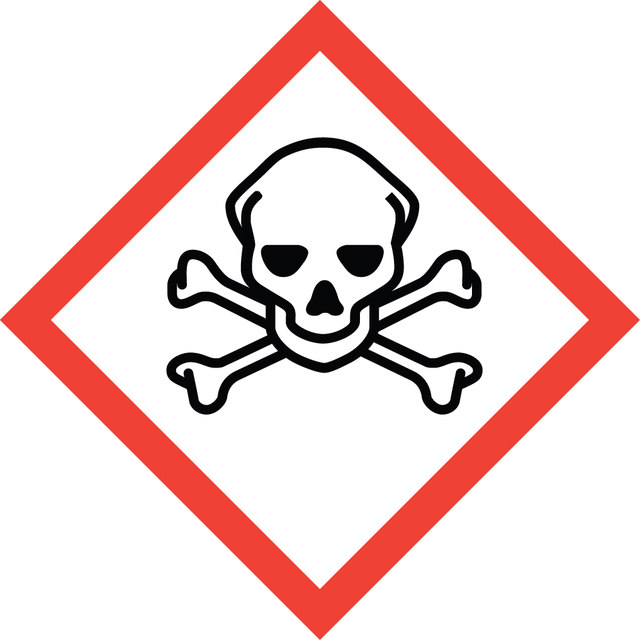
Skull and crossbonesHealth hazard

signalword

Danger

Hazard Classifications

Acute Tox. 3 Dermal - Acute Tox. 3 Inhalation - Acute Tox. 3 Oral - Aquatic Chronic 3 - Carc. 1B - Eye Irrit. 2 - Muta. 2 - Repr. 1B - STOT RE 1 Inhalation

target_organs

Kidney,Liver,Mucous membranes

存储类别

6.1C - Combustible acute toxic Cat.3 / toxic compounds or compounds which causing chronic effects

wgk

WGK 3

flash_point_f

165.2 °F - DIN 51758

flash_point_c

74 °C - DIN 51758

ppe

Eyeshields, Faceshields, Gloves, type ABEK (EN14387) respirator filter

法规信息

危险化学品
此项目有

历史批次信息供参考:

分析证书(COA)

Lot/Batch Number

没有发现合适的版本?

如果您需要特殊版本,可通过批号或批次号查找具体证书。

已有该产品?

在文件库中查找您最近购买产品的文档。

访问文档库

Ghufrana Samin et al.
Environmental science and pollution research international, 19(8), 3067-3078 (2012-08-10)
1,2,3-Trichloropropane (TCP) is a persistent groundwater pollutant and a suspected human carcinogen. It is also is an industrial chemical waste that has been formed in large amounts during epichlorohydrin manufacture. In view of the spread of TCP via groundwater and
Eakalak Khan et al.
Journal of hazardous materials, 161(2-3), 1024-1034 (2008-05-27)
The mineralization and biodegradability increase and their combination of two traditional and two relatively new organic contaminants by Fenton reagents with three different types of iron, Fe(2+), Fe(3+), and Fe(0) were investigated. The traditional contaminants examined were trichloroethene (TCE) and
Vaishnavi Sarathy et al.
Environmental science & technology, 44(2), 787-793 (2009-12-17)
1,2,3-Trichloropropane (TCP) is an emerging contaminant because of increased recognition of its occurrence in groundwater, potential carcinogenicity, and resistance to natural attenuation. The physical and chemical properties of TCP make it difficult to remediate, with all conventional options being relatively
Jan G E van Leeuwen et al.
Chembiochem : a European journal of chemical biology, 13(1), 137-148 (2011-11-24)
We used directed evolution to obtain enantiocomplementary haloalkane dehalogenase variants that convert the toxic waste compound 1,2,3-trichloropropane (TCP) into highly enantioenriched (R)- or (S)-2,3-dichloropropan-1-ol, which can easily be converted into optically active epichlorohydrins-attractive intermediates for the synthesis of enantiopure fine
Grace E Kissling et al.
Toxicological sciences : an official journal of the Society of Toxicology, 92(1), 143-156 (2006-04-04)
There has been considerable interest in the use of small fish models for detecting potential environmental carcinogens. In this study, both guppies (Poecilia reticulata) and medaka (Oryzias latipes) were exposed in the aquaria water to three known rodent carcinogens for

我们的科学家团队拥有各种研究领域经验,包括生命科学、材料科学、化学合成、色谱、分析及许多其他领域.

联系客户支持