
IM1014

Anti-Matriptase/MT-SP1 Rabbit pAb
liquid, Calbiochem®
别名:
Anti-Membrane-Type Serine Protease 1, Anti-Suppressor of Tumorgenicity 14
登录 查看组织和合同定价。
选择尺寸
变更视图
关于此项目
NACRES:
NA.41
UNSPSC Code:
12352203
Clone:
polyclonal
Species reactivity:
human
Application:
—
Citations:
16
biological source
rabbit
Quality Level
antibody form
affinity isolated antibody
antibody product type
primary antibodies
clone
polyclonal
form
liquid
contains
≤0.1% sodium azide as preservative
species reactivity
human
manufacturer/tradename
Calbiochem®
storage condition
OK to freeze
dilution
(Immunoblotting (1:500-1:2000)
Immunoprecipitation (5-20 µg/mg lysate))
isotype
IgG
shipped in
wet ice
storage temp.
2-8°C
target post-translational modification
unmodified
Gene Information
human ... ST14(6768)
General description
Immunoaffinity purified rabbit polyclonal antibody. Recognizes the ~75 kDa matriptase protein.
Recognizes the ~75 kDa matriptase protein in MCF-7 cells.
This Anti-Matriptase/MT-SP1 Rabbit pAb is validated for use in Immunoblotting, Immunoprecipitation for the detection of Matriptase/MT-SP1.
Immunogen
Human
a synthetic peptide corresponding to amino acids near the C-terminus of human matriptase
Application
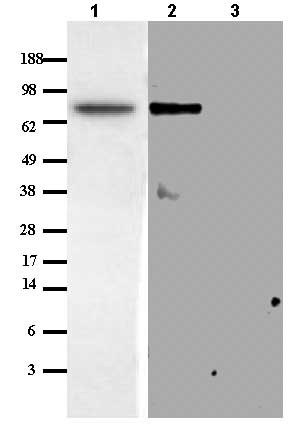
Immunoblotting (1:500-1:2000)
Immunoprecipitation (5-20 g/mg lysate)
Packaging
Please refer to vial label for lot-specific concentration.
Physical form
In Tris-citrate/phosphate buffer, pH 7.0-8.0.
Preparation Note
Following initial use, aliquot and freeze (-20°C) for long-term storage. Avoid freeze/thaw cycles.
Analysis Note
Positive Control
MCF-7 cells
MCF-7 cells
Other Notes
Antibody should be titrated for optimal results in individual systems.
Santin, A.D., et al. 2003. Cancer98, 1898.
Takeuchi, T., et al. 2000. J. Biol. Chem.275, 26333.
Lin, C.Y., et al. 1999. J. Biol. Chem.274, 18231.
Takeuchi, T., et al. 1999. Proc. Natl. Acad. Sci. USA96, 11054.
Takeuchi, T., et al. 2000. J. Biol. Chem.275, 26333.
Lin, C.Y., et al. 1999. J. Biol. Chem.274, 18231.
Takeuchi, T., et al. 1999. Proc. Natl. Acad. Sci. USA96, 11054.
Legal Information
CALBIOCHEM is a registered trademark of Merck KGaA, Darmstadt, Germany
Disclaimer
Toxicity: Highly Toxic (H)
Still not finding the right product?
试用我们的 产品选型工具 工具缩小选择范围
存储类别
10 - Combustible liquids
wgk
WGK 1
flash_point_f
Not applicable
flash_point_c
Not applicable
Marguerite S Buzza et al.
The Journal of biological chemistry, 292(26), 10801-10812 (2017-05-12)
Compromised gastrointestinal barrier function is strongly associated with the progressive and destructive pathologies of the two main forms of irritable bowel disease (IBD), ulcerative colitis (UC), and Crohn's disease (CD). Matriptase is a membrane-anchored serine protease encoded by suppression of
Sine Godiksen et al.
PloS one, 8(10), e77146-e77146 (2013-11-10)
Matriptase is a member of the family of type II transmembrane serine proteases that is essential for development and maintenance of several epithelial tissues. Matriptase is synthesized as a single-chain zymogen precursor that is processed into a two-chain disulfide-linked form
Sine Godiksen et al.
The Biochemical journal, 413(2), 251-259 (2008-04-12)
HAI-1 [HGF (hepatocyte growth factor) activator inhibitor-1] is a Kunitz-type transmembrane serine protease inhibitor that forms inhibitor complexes with the trypsin-like serine protease, matriptase. HAI-1 is essential for mouse placental development and embryo survival and together with matriptase it is
全球贸易项目编号
| 货号 | GTIN |
|---|---|
| IM1014-50UG | 04055977228175 |