Skip to Content
Merck
CN

N13586

Toxaphene

analytical standard

Sign In to View Organizational & Contract Pricing.

Select a Size


About This Item

CAS Number:
UNSPSC Code:
41116107
EC Number:
232-283-3
Technical Service
Need help? Our team of experienced scientists is here for you.
Let Us Assist
Technical Service
Need help? Our team of experienced scientists is here for you.
Let Us Assist

InChI key

OEJNXTAZZBRGDN-UHFFFAOYSA-N

InChI

1S/C10H8Cl8/c1-4-7(2-11,3-12)9(16)6(14)5(13)8(4,15)10(9,17)18/h5-6H,1-3H2

grade

analytical standard

packaging

ampule of 250 mg

manufacturer/tradename

Chem Service, Inc. PS-79

technique(s)

HPLC: suitable, gas chromatography (GC): suitable

application(s)

cleaning products
cosmetics
food and beverages
personal care

format

neat

Application
Refer to the product′s Certificate of Analysis for more information on a suitable instrument technique. Contact Technical Service for further support.

signalword

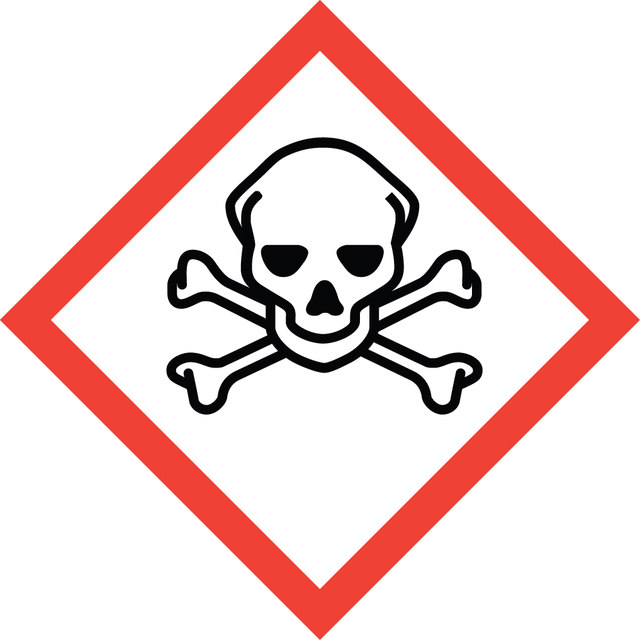
Danger

Hazard Classifications

Acute Tox. 2 Oral - Acute Tox. 4 Dermal - Aquatic Acute 1 - Aquatic Chronic 1 - Carc. 2 - Skin Irrit. 2 - STOT SE 3

target_organs

Respiratory system

Storage Class

6.1A - Combustible acute toxic Cat. 1 and 2 / very toxic hazardous materials

wgk

WGK 3

flash_point_f

Not applicable

flash_point_c

Not applicable

Regulatory Information

监管及禁止进口产品
This item has

Choose from one of the most recent versions:

Certificates of Analysis (COA)

Lot/Batch Number

It looks like we've run into a problem, but you can still download Certificates of Analysis from our Documents section.

If you need assistance, please contact Customer Support

Already Own This Product?

Find documentation for the products that you have recently purchased in the Document Library.

Visit the Document Library

Pim E G Leonards et al.
Integrated environmental assessment and management, 8(3), 523-529 (2011-12-14)
A revised risk assessment for toxaphene was developed, based on the assumption that fish consumers are only exposed to toxaphene residues that differ substantially from technical toxaphene due to environmental degradation and metabolism. In vitro studies confirmed that both technical
Wenjian Lao et al.
Journal of chromatography. A, 1270, 262-268 (2012-11-20)
Determinative methods based on gas chromatography-negative chemical ionization mass spectrometry (GC-NCI/MS) provide improved sensitivity and specificity for toxaphene in environmental samples, but are subject to misidentification due to oxygen reaction in the presence of polychlorinated biphenyls (PCBs). The goal of
Louise Champoux et al.
Environmental toxicology and chemistry, 29(2), 243-249 (2010-09-08)
The great blue heron (Ardea herodias) has been used as a bioindicator of the state of the St. Lawrence River (Québec, Canada) since 1996. At 5-year intervals, selected breeding colonies along the River and its estuary are visited to estimate
Juan José Alava et al.
Environmental toxicology and chemistry, 30(7), 1677-1688 (2011-04-22)
Persistent organic pollutants (POPs) are recognized manmade threats to sea turtle populations, but substantial uncertainty exists surrounding their exposure to contaminants and their sensitivity to toxic effects. This uncertainty creates difficulty for conservation managers to make informed decisions for the
Toxaphene.
Report on carcinogens : carcinogen profiles, 12, 418-420 (2011-08-25)

Our team of scientists has experience in all areas of research including Life Science, Material Science, Chemical Synthesis, Chromatography, Analytical and many others.

Contact Technical Service