
752924

2,2,2-Trifluoroethyl trifluoromethanesulfonate
95%
Synonym(s):
Trifluoromethanesulfonic acid 2,2,2-trifluoroethyl ester
Sign In to View Organizational & Contract Pricing.
Select a Size
About This Item
Empirical Formula (Hill Notation):
C3H2F6O3S
CAS Number:
Molecular Weight:
232.10
NACRES:
NA.22
PubChem Substance ID:
UNSPSC Code:
12352101
MDL number:
Assay:
95%
Form:
liquid
InChI
1S/C3H2F6O3S/c4-2(5,6)1-12-13(10,11)3(7,8)9/h1H2
SMILES string
FC(F)(F)COS(=O)(=O)C(F)(F)F
InChI key
RTMMSCJWQYWMNK-UHFFFAOYSA-N
assay
95%
form
liquid
refractive index
n20/D 1.306
density
1.611 g/mL at 25 °C
functional group
fluoro, triflate
storage temp.
2-8°C
Quality Level
Related Categories
Application
Reagent used in thenantioselective preparation of cyclic N-aryl hydroxamic acids via phase-transfer catalyzed alkylation of nitrobenzyl bromides to give nirophenylalanines
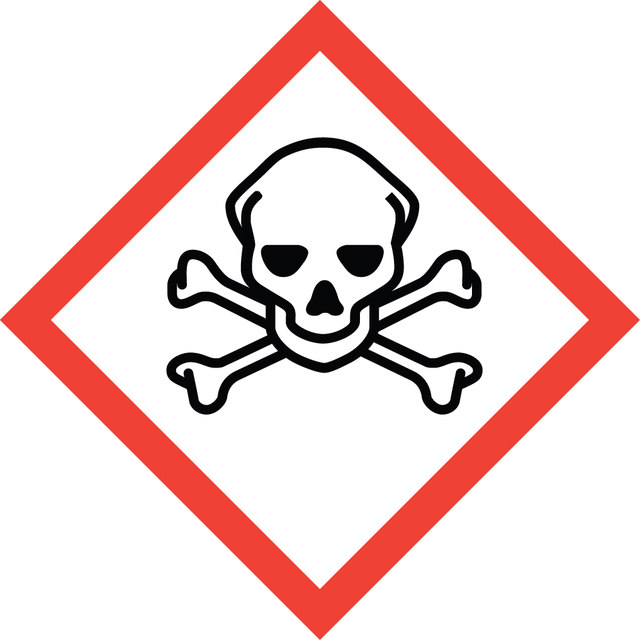

signalword
Danger
hcodes
Hazard Classifications
Acute Tox. 2 Inhalation - Acute Tox. 3 Oral - Skin Corr. 1B
Storage Class
6.1A - Combustible acute toxic Cat. 1 and 2 / very toxic hazardous materials
wgk
WGK 3
flash_point_f
Not applicable
flash_point_c
Not applicable
Choose from one of the most recent versions:
Already Own This Product?
Find documentation for the products that you have recently purchased in the Document Library.
Laura A McAllister et al.
The Journal of organic chemistry, 76(9), 3484-3497 (2011-04-02)
We describe a generalized approach to stereocontrolled synthesis of substituted cyclic hydroxamic acids (3-amino-1-hydroxy-3,4-dihydroquinolinones) by selective reduction of substituted 2-nitrophenylalanine substrates. Compounds in this series have antibacterial properties and have also recently been reported as KAT II inhibitors. The key
Related Content
Baran Reagents - FAQ
Our team of scientists has experience in all areas of research including Life Science, Material Science, Chemical Synthesis, Chromatography, Analytical and many others.
Contact Technical Service