Skip to Content
Merck
CN

675644

Chromium(VI) oxide

99.99% trace metals basis

Synonym(s):

Chromium trioxide, Chromic trioxide, Chromium VI trioxide, Chromic anhydride

Sign In to View Organizational & Contract Pricing.

Select a Size


About This Item

Empirical Formula (Hill Notation):
CrO3
CAS Number:
Molecular Weight:
99.99
NACRES:
NA.23
PubChem Substance ID:
UNSPSC Code:
12352303
EC Number:
215-607-8
MDL number:
Technical Service
Need help? Our team of experienced scientists is here for you.
Let Us Assist
Technical Service
Need help? Our team of experienced scientists is here for you.
Let Us Assist

InChI

1S/Cr.3O

InChI key

WGLPBDUCMAPZCE-UHFFFAOYSA-N

SMILES string

O=[Cr](=O)=O

assay

99.99% trace metals basis

form

powder or flakes

reaction suitability

reagent type: oxidant

mp

196 °C (dec.) (lit.)

application(s)

battery manufacturing

Quality Level

Looking for similar products? Visit Product Comparison Guide

General description
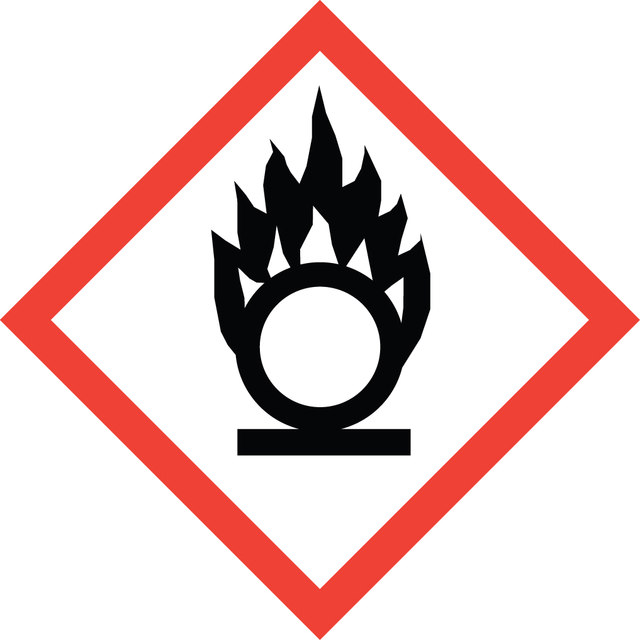
Chromium(VI) oxide (CrO3) is a hexavalent chromium that is majorly used as an oxidizing agent. It oxidizes the C-H bonds in the aromatic rings to form benzoic acid from alkyl benzene. It can be prepared by adding concentrated sulphuric acid in potassium dichromate.

signalword

Danger

Hazard Classifications

Acute Tox. 2 Inhalation - Acute Tox. 3 Dermal - Acute Tox. 3 Oral - Aquatic Acute 1 - Aquatic Chronic 1 - Carc. 1A - Eye Dam. 1 - Muta. 1B - Ox. Sol. 1 - Repr. 2 - Resp. Sens. 1 - Skin Corr. 1A - Skin Sens. 1 - STOT RE 1 Inhalation - STOT SE 3

target_organs

Respiratory system

Storage Class

5.1A - Strongly oxidizing hazardous materials

wgk

WGK 3

flash_point_f

Not applicable

flash_point_c

Not applicable

ppe

Eyeshields, Faceshields, Gloves, type P3 (EN 143) respirator cartridges

Regulatory Information

危险化学品
This item has

Choose from one of the most recent versions:

Certificates of Analysis (COA)

Lot/Batch Number

Don't see the Right Version?

If you require a particular version, you can look up a specific certificate by the Lot or Batch number.

Already Own This Product?

Find documentation for the products that you have recently purchased in the Document Library.

Visit the Document Library

Chromium Oxidations in Organic Chemistry (2011)
S Y Shiau et al.
The Journal of nutrition, 123(10), 1747-1753 (1993-10-01)
An experiment was conducted to study the influence of three different forms of chromium (CrCl3.6H2O, Na2CrO4.4H2O and Cr2O3) on the utilization of two carbohydrates (glucose and cornstarch) by juvenile hybrid tilapia (Oreochromis niloticus x O. aureus). Average initial body weight
Francis Pierre et al.
International archives of occupational and environmental health, 81(3), 321-329 (2007-07-03)
This study is concerned with two specific chromium (Cr) exposure situations at a hard-process electroplating company. Its aims are to define variations in urinary Cr concentration and to clarify their exposure relationships. Airborne chromium exposure and urinary excretion were measured
Seongmin Lee et al.
Organic letters, 11(1), 5-8 (2008-12-06)
The C14,15-dihydro-C22,25-epi north unit of cephalostatin 1 has been synthesized in 11 operations from commercially available hecogenin acetate via multiple reductions and oxidations. The key transformations include (i) Cr(VI)-catalyzed E-ring opening, (ii) C17 hydroxylation, and (iii) a base-triggered cyclization cascade.
S Kondo et al.
European journal of biochemistry, 200(3), 689-698 (1991-09-15)
The chemical structure of the saccharide portion of Vibrio parahaemolyticus serotype 012 lipopolysaccharide was studied. Using chemical degradation and modification, as well as methylation analysis in combination with GLC-MS, laser-desorption mass spectrometry and 1H-NMR and 13C-NMR spectroscopy, the carbohydrate backbone

Articles

Magnetic materials find diverse applications from data storage to renewable energy.

Our team of scientists has experience in all areas of research including Life Science, Material Science, Chemical Synthesis, Chromatography, Analytical and many others.

Contact Technical Service