Skip to Content
Merck
CN

206113

Platinum(IV) chloride

96%

Synonym(s):

Platinum tetrachloride

Sign In to View Organizational & Contract Pricing.

Select a Size


About This Item

Linear Formula:
PtCl4
CAS Number:
Molecular Weight:
336.89
PubChem Substance ID:
eCl@ss:
38191307
UNSPSC Code:
12352302
NACRES:
NA.23
EC Number:
236-645-1
MDL number:
Assay:
96%
Form:
powder and chunks
Technical Service
Need help? Our team of experienced scientists is here for you.
Let Us Assist
Technical Service
Need help? Our team of experienced scientists is here for you.
Let Us Assist

Product Name

Platinum(IV) chloride, 96%

InChI key

FBEIPJNQGITEBL-UHFFFAOYSA-J

InChI

1S/4ClH.Pt/h4*1H;/q;;;;+4/p-4

SMILES string

Cl[Pt](Cl)(Cl)Cl

assay

96%

form

powder and chunks

reaction suitability

core: platinum
reagent type: catalyst

mp

370 °C (dec.) (lit.)

density

4.303 g/mL at 25 °C (lit.)

application(s)

PEM fuel cells
homogeneous catalyst
material synthesis precursor

Quality Level

Looking for similar products? Visit Product Comparison Guide

Application

Platinum(IV) chloride can be used as a precursor to synthesize Pt-based nanocatalysts for various organic transformations. For example, Carbon-supported Pt-Ru nanoparticles can be used as an efficient catalyst for methanol and ethanol oxidation.

Due to its high affinity to the glycosyl acceptor hydroxy groups and bidentate ligation capacity, it can be used as a dual catalyst for regio- and stereoselective glycosidation reactions.

It can also be used for the photosensitization and surface modification of TiO2 for the photodegradation of 4-chlorophenol.
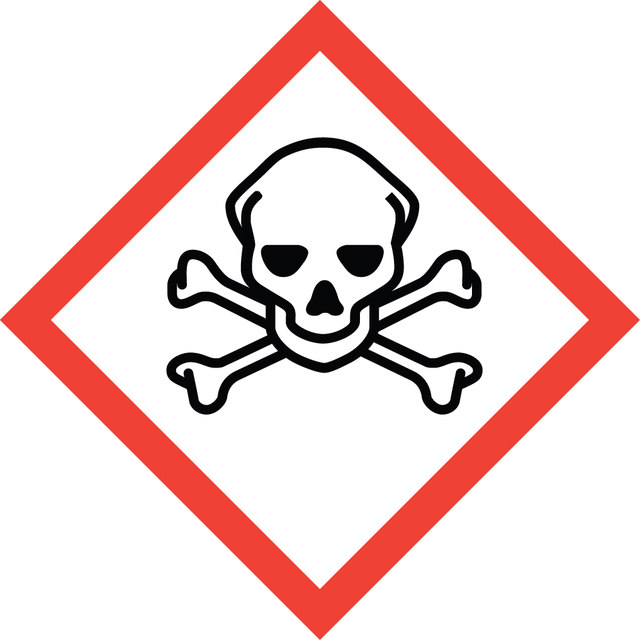

signalword

Danger

Hazard Classifications

Acute Tox. 3 Oral - Eye Dam. 1 - Resp. Sens. 1 - Skin Corr. 1B - Skin Sens. 1

Storage Class

6.1A - Combustible acute toxic Cat. 1 and 2 / very toxic hazardous materials

wgk

WGK 2

flash_point_f

Not applicable

flash_point_c

Not applicable

ppe

Eyeshields, Faceshields, Gloves, type P3 (EN 143) respirator cartridges


Choose from one of the most recent versions:

Certificates of Analysis (COA)

Lot/Batch Number

Don't see the Right Version?

If you require a particular version, you can look up a specific certificate by the Lot or Batch number.

Already Own This Product?

Find documentation for the products that you have recently purchased in the Document Library.

Visit the Document Library

Lu Zhao et al.
Zhejiang da xue xue bao. Yi xue ban = Journal of Zhejiang University. Medical sciences, 38(1), 59-66 (2009-03-03)
To construct a drug carrier and gene vector PEG-PEI-Pt. Polyethyleneglycol (PEG) was coupled to polyethylenimine (PEI 600) and platinum tetrachloride; PEG-PEI-Pt complex was formed in ethanol. The complex was characterized by XRD, UV-VIS and FT-IR and the DNA condensation was
Ivana Bednarova et al.
Neuro endocrinology letters, 33 Suppl 3, 107-112 (2013-01-29)
An enhanced worldwide application of platinum group elements (PGE), in particular platinum, has been observed during recent decades. An increased concentration of PGE was determined in collected samples of great amount of aqueous ecosystems.The aim was to compare phytotoxic effect
Eric Ennifar et al.
Nucleic acids research, 31(10), 2671-2682 (2003-05-09)
Metal ions, and magnesium in particular, are known to be involved in RNA folding by stabilizing secondary and tertiary structures, and, as cofactors, in RNA enzymatic activity. We have conducted a systematic crystallographic analysis of cation binding to the duplex
N Kanematsu et al.
Gifu Shika Gakkai zasshi = The Journal of Gifu Dental Society, 17(2), 575-581 (1990-12-01)
The induction of mutation by cadmium chloride (CdCl2), platinum tetrachloride (PtCl4), and rhodium trichloride (RhCl3.3H2O) was measured utilizing the hypoxanthine-guanine phosphoribosyl transferase (HGPRT) locus in V-79 cells. Cadmium chloride at a concentration of 0.05 microM induced ford mutation in V-79
B A Teicher et al.
Anticancer research, 13(5A), 1549-1556 (1993-09-01)
Since several anticancer drugs are known to become more cytotoxic to cells in an acidic milieu, we have attempted to utilize the carbonic anhydrase inhibitor, Acetazolamide, to acidify the blood and tumor of C3H mice bearing the FSaIIC fibrosarcoma in

Our team of scientists has experience in all areas of research including Life Science, Material Science, Chemical Synthesis, Chromatography, Analytical and many others.

Contact Technical Service