
Skip to Content
Merck
CN

186384

N,N-Dimethyl-p-phenylenediamine sulfate salt

98%

Synonym(s):

4-(Dimethylamino)aniline sulfate salt, 4-Amino-N,N-dimethylaniline sulfate salt, DMPPDA

Sign In to View Organizational & Contract Pricing.

Select a Size


About This Item

Linear Formula:
(CH3)2NC6H4NH2·H2SO4
CAS Number:
Molecular Weight:
234.27
UNSPSC Code:
12352100
NACRES:
NA.22
PubChem Substance ID:
EC Number:
208-636-2
Beilstein/REAXYS Number:
4612278
MDL number:
Technical Service
Need help? Our team of experienced scientists is here for you.
Let Us Assist
Technical Service
Need help? Our team of experienced scientists is here for you.
Let Us Assist

Product Name

N,N-Dimethyl-p-phenylenediamine sulfate salt, 98%

InChI key

GLUKPDKNLKRLHX-UHFFFAOYSA-N

InChI

1S/C8H12N2.H2O4S/c1-10(2)8-5-3-7(9)4-6-8;1-5(2,3)4/h3-6H,9H2,1-2H3;(H2,1,2,3,4)

SMILES string

OS(O)(=O)=O.CN(C)c1ccc(N)cc1

assay

98%

form

solid

bp

495 °C (lit.)

mp

200-205 °C (dec.) (lit.)

solubility

water: soluble 50 mg/mL, clear to hazy, colorless to faintly yellow or pink

functional group

amine

Quality Level

Looking for similar products? Visit Product Comparison Guide

Application

N,N-Dimethyl-p-phenylenediamine sulfate salt was used:
  • to investigate the role of H2S in cardioprotection induced by ischemic preconditioning in rat heart
  • in spectrophotometric determination of gold(III) in gold-pharmaceuticals such as sodium aurothimaleate and auranofin
  • to investigate colonic tissue H2S production using the acetate trapping assay system
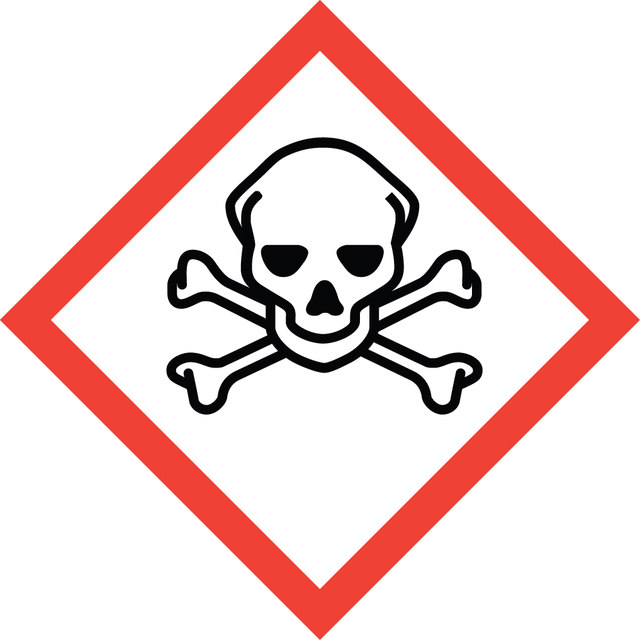
pictograms

Skull and crossbones

signalword

Danger

Hazard Classifications

Acute Tox. 3 Dermal - Acute Tox. 3 Inhalation - Acute Tox. 3 Oral - Eye Irrit. 2 - Skin Irrit. 2 - STOT SE 3

target_organs

Respiratory system

Storage Class

6.1A - Combustible acute toxic Cat. 1 and 2 / very toxic hazardous materials

wgk

WGK 3

flash_point_f

Not applicable

flash_point_c

Not applicable

ppe

Eyeshields, Faceshields, Gloves, type P2 (EN 143) respirator cartridges

Regulatory Information

危险化学品
This item has

Choose from one of the most recent versions:

Certificates of Analysis (COA)

Lot/Batch Number

Don't see the Right Version?

If you require a particular version, you can look up a specific certificate by the Lot or Batch number.

Already Own This Product?

Find documentation for the products that you have recently purchased in the Document Library.

Visit the Document Library

New and sensitive spectrophotometric determination of gold (III) with N, N-dimethyl-p-phenylenediamine and potassium persulfate.
Mori I, et al.
Analytical Letters, 30(5), 953-961 (1997)
Jin-Song Bian et al.
The Journal of pharmacology and experimental therapeutics, 316(2), 670-678 (2005-10-06)
Endogenous H(2)S is synthesized mainly by cystathionine gamma-lyase in the heart. The present study investigated the role of H(2)S in cardioprotection induced by ischemic preconditioning. We have examined the effect of endogenous H(2)S and exogenous application of NaHS (H(2)S donor)
Kyle L Flannigan et al.
American journal of physiology. Gastrointestinal and liver physiology, 301(1), G188-G193 (2011-04-09)
Hydrogen sulfide (H(2)S) is an important modulator of many aspects of digestive function, both in health and disease. Colonic tissue H(2)S synthesis increases markedly during injury and inflammation and appears to contribute to resolution. Some of the bacteria residing in
K Wimalasena et al.
The Journal of biological chemistry, 271(42), 26032-26043 (1996-10-18)
The interactions of reductants with dopamine beta-monooxygenase (DbetaM) were examined using two novel classes of reductants. The steady-state kinetics of the previously characterized DbetaM reductant, N,N-dimethyl-1,4-p-phenylenediamine (DMPD), were parallel to the ascorbic acid-supported reaction with respect to pH dependence and
Joseph B Issa et al.
The journal of physical chemistry. B, 111(24), 6878-6886 (2007-06-02)
Photoinduced intramolecular charge separation across proline-bridged donor-acceptor complexes of the type Pyr-(Pro)n-DMPD (where Pyr=pyrene-1-sulfonyl and DMPD=N,N-dimethyl-1,4-phenylenediamine) was studied. The steady-state emission spectrum for n=0, 1, 2, 3 showed an increase in emission intensity with the number of proline residues. Time-dependent

Our team of scientists has experience in all areas of research including Life Science, Material Science, Chemical Synthesis, Chromatography, Analytical and many others.

Contact Technical Service